



REVESCO. Revista de Estudios Cooperativos. ARTÍCULOS
e-ISSN: 1985-8031
Conceição
Castro CEOS.PP,
ISCAP, Polytechnic of Porto, Portugal 
 ; Jorge
Muñoz Université
de Bretagne Occidentale (Francia) ; Raquel
Pereira CEOS.PP,
ISCAP, Polytechnic of Porto, Portugal
;
Susana
Bernardino CEOS.PP,
ISCAP, Polytechnic of Porto, Portugal
;
Claudia
Pinto CEOS.PP,
ISCAP, Polytechnic of Porto, Portugal
;
Deolinda
Meira CEOS.PP,
ISCAP, Polytechnic of Porto, Portugal
;
Paloma
Bel Universidad
Complutense de Madrid (España) ; Gustavo
Lejarriaga Universidad
Complutense de Madrid (España) ; María José
Vañó Universitat
de Valencia (España) ; Mario
Radrigán Universidad
de Santiago de Chile (Chile) ; Luis
Hernández Universidad
de Santiago de Chile (Chile) ; Millán
Díaz Universidad
de Zaragoza (España) ; Luca Gori Scuola
Superiore Sant’Anna di Pisa (Italia) ; Paolo
Addis Scuola
Superiore Sant’Anna di Pisa (Italia)
; Jorge
Muñoz Université
de Bretagne Occidentale (Francia) ; Raquel
Pereira CEOS.PP,
ISCAP, Polytechnic of Porto, Portugal
;
Susana
Bernardino CEOS.PP,
ISCAP, Polytechnic of Porto, Portugal
;
Claudia
Pinto CEOS.PP,
ISCAP, Polytechnic of Porto, Portugal
;
Deolinda
Meira CEOS.PP,
ISCAP, Polytechnic of Porto, Portugal
;
Paloma
Bel Universidad
Complutense de Madrid (España) ; Gustavo
Lejarriaga Universidad
Complutense de Madrid (España) ; María José
Vañó Universitat
de Valencia (España) ; Mario
Radrigán Universidad
de Santiago de Chile (Chile) ; Luis
Hernández Universidad
de Santiago de Chile (Chile) ; Millán
Díaz Universidad
de Zaragoza (España) ; Luca Gori Scuola
Superiore Sant’Anna di Pisa (Italia) ; Paolo
Addis Scuola
Superiore Sant’Anna di Pisa (Italia)
https://dx.doi.org/10.5209/REVE.106901 Recibido: 30/06/2025 • Aceptado: 23/12/2025 • Publicado: 20/04/2026
ES Resumen. El emprendimiento social constituye un ámbito de acción que propone un enfoque innovador para afrontar los desafíos sociales. Aunque existen diversas interpretaciones del concepto, hay cierto consenso en que este campo se centra en generar soluciones a problemáticas sociales mediante estrategias emprendedoras.
A pesar del creciente reconocimiento de su relevancia en los últimos años, el conocimiento profundo sobre las distintas dimensiones del emprendimiento social sigue siendo limitado, especialmente entre los jóvenes.
Este artículo tiene como objetivo analizar las percepciones de estudiantes de educación superior sobre el emprendimiento social desde una perspectiva internacional. Se empleó una metodología cuantitativa, a través de una encuesta aplicada a estudiantes de diversas instituciones de educación superior en distintos países, obteniéndose un total de 434 respuestas válidas.
Los resultados revelan que, en general, los participantes comprenden los principios fundamentales del emprendimiento social, en particular su papel en la resolución de retos sociales y medioambientales mediante enfoques innovadores y sostenibles. No obstante, persisten ciertos conceptos erróneos, ya que algunos estudiantes perciben las empresas sociales como negocios con fines de lucro similares a las empresas tradicionales.
Asimismo, los hallazgos destacan el papel de la educación en la formación de las percepciones estudiantiles: aquellos que habían recibido formación en emprendimiento mostraron una mayor capacidad para distinguir con precisión las características distintivas del emprendimiento social frente a los modelos de negocio convencionales.
Estos resultados subrayan la importancia de integrar la educación en emprendimiento social en los planes de estudio de la educación superior, con el fin de mejorar la comprensión de los estudiantes y fomentar una participación más activa en iniciativas emprendedoras con impacto social.
Palabras clave. Emprendimiento social, percepciones de los estudiantes, instituciones de educación superior, economía social, innovación social.
Claves Econlit. L31, I26, O35.
ENG Perceptions of social entrepreneurship among higher education students: an international perspective
ENG Abstract. Social entrepreneurship refers to a field of action that proposes an innovative approach to solving social challenges. Although there are different interpretations of the concept, there is some consensus that the field of social entrepreneurship focuses on creating solutions to social problems through entrepreneurial strategies.
Despite the growing recognition of the importance of social entrepreneurship in recent years, in-depth knowledge of the different dimensions of this concept remains limited, especially among younger people.
This article aims to analyse higher education students' perceptions of social entrepreneurship from an international perspective. A quantitative methodology was employed through a questionnaire survey administered to students from various higher education institutions across different countries. A total of 434 valid responses were collected.
The results indicate that the participants generally demonstrate an understanding of the core principles of social entrepreneurship, particularly its role in addressing social and environmental challenges through innovative and sustainable approaches. However, some misconceptions persist, with a proportion of students perceiving social enterprises as profit-driven businesses similar to traditional enterprises. The results also highlight the role of education in shaping students’ perceptions, as those with entrepreneurship training were more likely to accurately distinguish some distinctive characteristics of social entrepreneurship from conventional business models. These findings underscore the importance of integrating social entrepreneurship education into higher education curricula to enhance students' understanding and encourage greater engagement in entrepreneurial initiatives with a social impact.
Keywords. Social Entrepreneurship, students’ perceptions, higher education institutions, social economy, social innovation.
Summary. 1. Introduction. 2. Theoretical framework. 3. Methodology. 4. Results. 5. Conclusions. 6. References.
How to cite: Castro, C.; Muñoz, J., Pereira, R.; Bernardino, S.; Pinto, C.; Meira, D.; Bel, P.; Lejarriaga, G.; Vaño, M.J.; Radrigán, M.; Hernández, L.; Díaz, M.; Gori, L.; Addis, P. (2026). Perceptions of social entrepreneurship among higher education students: an international perspective. REVESCO. Revista de Estudios Cooperativos, 152, e106901. https://dx.doi.org/10.5209/REVE.106901.
Given the economic, social, and environmental challenges facing the world today, where social inequalities, climate change, sustainability imperatives, and economic pressures demand innovative and sustainable solutions (Langer, 2024; Yunus, 2010), Social Entrepreneurship (SE) stands as one of the most notable innovations of global civil society in recent times (Nicholls & Collavo, 2019). Bataineh et al. (2023) point out that linking social entrepreneurship and sustainable development is presented as a process that seeks sustainable solutions to social, economic, and environmental challenges, through the continuous enhancement of operational effectiveness. The Global Entrepreneurship Monitor (GEM, 2015) has defined SE as any initiative, activity, or organisation that has a social, environmental, or community-based objective. Although there is no single and globally accepted concept of SE, the literature analysis indicates a certain convergence that SE represents an innovative approach combining business practices to create value and development by solving complex social problems (Canestrino et al., 2020; Zahra et al., 2009; Dees, 2012). Recently Gintere and Licite-Kurbe (2022) studies point to a definition of SE as a fusion of social purposes and business practices with a focus on solving social issues and problems while using market-based strategies.
Unlike traditional entrepreneurship, which aims to generate profit, the gains and results of SE are measured by the number of people these initiatives can reach and positively impact. According to Saebi et al. (2019) social entrepreneurship integrates a social mission into its business model to generate sustainable positive impact. In fact, SE has been considered as a catalyst for economic growth and societal progress, particularly in regions where state mechanisms are ineffective in addressing social needs (Popov, 2018). According to research by Zhang et al (2022) on the impact that SE has on the sustainable development of rural areas, SE has made a significant contribution to poverty reduction. This study concludes that traditional methods of poverty reduction - such as government support and corporate social responsibility - are often insufficient due to their intrinsic limitations, such as insufficient capital and a lack of motivation among local actors. Thus SE, defined as an innovative approach that aligns economic efficiency with social objectives, presents itself as a fundamental process for involving local communities in economic activities, while addressing their social, economic and ecological challenges.
Due to its enormous potential, SE has become increasingly important, in both academic and professional contexts (Canestrino et al., 2020; Nicholls, 2010). However, despite the strong social impact that entrepreneurship can have, as well as its role in growth and job creation, data from GEM (2015) suggests that levels of SE are much lower than those observed in profit-driven entrepreneurship. In a recent report, GEM (2024) warns that more action from policymakers and other stakeholders is needed since entrepreneurial education continues to be rated low in most economies. One of the challenges faced by SE is the need for specific training for social entrepreneurs (Chang et al., 2022). Therefore, policies for entrepreneurial education and specific training programs in the field of the social economy must be developed, as they are tools capable of promoting the capacity for action and the development of new social projects and organisations (Meira et al., 2020; Melian et al., 2017; Parente et al., 2014).
This work is being developed with the primary objective of conducting a diagnostic to understand the perceptions of students from the five higher education institutions involved in the study in relation to social entrepreneurship.
Given the growing international relevance of social entrepreneurship as a tool to address global challenges and recognizing that students' awareness and understanding of social entrepreneurship is crucial to fostering future social innovation, this study seeks to identify not only their perceptions, knowledge and attitudes towards SE, but also other dimensions of SE arising from their countries' socio-economic contexts.
To this end, section 2 presents the theoretical framework by reviewing the concept of SE and its evolution. Section 3 describes the methodology used in the research, followed by the presentation of the results of the exploratory phase in section 4. Finally, the main conclusions are presented.
The study of SE as an autonomous field of research emerged mainly in the 1990s with the work of Dees (1998). Indeed, the author was one of the first to present a formal conceptualisation of its representation by defining the social entrepreneur as an agent of change who, similarly to traditional entrepreneurs, identifies opportunities and applies innovative solutions. However, the key difference lies in the fact that their primary goal is not to make a profit but rather to create impact and drive social change. Social entrepreneurs are, therefore, change agents who apply the principles and strategies of entrepreneurship, and develop innovative solutions to the challenges faced by society.
Younis et al. (2021) state that the definition of SE includes meeting social needs. The concept also includes promoting social change through innovative ideas (Nicholls, 2008), responding to situations of instability (Thompson et al., 2000), and implementing market-driven actions aimed at creating social value (Bacq & Janssen, 2011).
In fact, the phenomenon of SE is multifaceted, as it encompasses different contexts, approaches, and objectives (Mair & Marti, 2006). The authors argue that the concept should be seen as a multidisciplinary field of research, incorporating elements from economics, management, social innovation, and public policy. Nicholls (2008) reinforces this view, highlighting that social entrepreneurship can take various forms, ranging from nonprofit organisations to hybrid enterprises that combine social and economic objectives. Douglas and Prentice (2019) explore the multifaceted nature of SE, highlighting its fundamental pillars: pro-social motivation, innovation and profit-making. This study argues that although the main motivation of social entrepreneurs is usually the provision of social benefits, many also seek to make profits as a secondary objective in order to attract investment and promote growth, thus positioning themselves as ‘hybrid’ social entrepreneurs. Therefore, the author emphasises the complexity and heterogeneity of the motivations and paths to SE, suggesting that different individuals may seek similar opportunities based on different attitudes, expectations and efficiencies.
Despite its broad scope, multifaceted nature, and the existence of different interpretations of the concept of SE, there is some consensus that this field of activity involves creating responses to social challenges or problems through entrepreneurial approaches. Indeed, there is some convergence in the literature on the understanding that SE involves business activities and entrepreneurial behaviour with the aim of creating social value and solving existing social problems (Austin et al., 2006; Dees, 2012). Leadbeater (1997) presents the social entrepreneur as an entrepreneurial, innovative, and transformative individual who, having identified a social problem, organises, creates, and manages a venture to drive social change. In turn, seeking to integrate the key factors of social entrepreneurship, Abu-Saifan (2012, p. 25) defines the social entrepreneur as “a mission-driven individual who uses a set of entrepreneurial behaviours to deliver a social value to the less privileged, all through an entrepreneurially oriented entity that is financially independent, self-sufficient, or sustainable.” According to Zahra et al. (2009), SE involves the development of activities and processes aimed at exploring opportunities to enhance social wealth by creating new ventures or managing existing organisations in an innovative way. Santos (2012) argues that SE should be understood as a model of institutional innovation capable of transforming systems and generating structural changes in society. Similarly, Bernardino and Freitas Santos (2023) state that SE is a highly complex phenomenon, reflecting the application of the entrepreneurship concept to the social sector or, more broadly, to the provision of products or services with a social purpose.
Although social entrepreneurship is not easy to define and describe - as its nature requires a combination of logics and activities typical of the social economy and the public sectors with those associated with the business sector (Nicholls & Collavo, 2019) - it represents one of the most remarkable innovations of global civil society in recent times (Nicholls & Collavo, 2019).
In recent decades, SE has become increasingly important and plays an ever more relevant role in both academic and professional spheres (Nicholls, 2010). This development reflects its importance and ability to find innovative and sustainable solutions to complex social challenges (Asma et al., 2019; Neumann, 2020; Mohammadi et al., 2024; Zahra et al., 2008). This growing interest stems from the recognition that entrepreneurial initiatives, when directed toward the common good, can significantly contribute to improving the living conditions of communities and addressing issues such as poverty, social exclusion, economic inequalities, environmental concerns, and sustainability (Bornstein & Davis, 2010; Mair & Marti, 2006, Zhang et al., 2022).
The emergence and consolidation of SE reflect a paradigm shift in how social problems are addressed, prioritising creative, sustainable solutions with long-term impact. The literature has highlighted the role of social entrepreneurs in developing innovative business models that combine economic efficiency with positive social impact (Kickul et al., 2022). These change agents employ adaptable and sustainable strategies to address unmet needs that are not meet by traditional public and private sectors (Dees, 1998; Zaremohzzabieh et al., 2019). SE values innovation and creative market-based solutions that contribute to the common good— a characteristic that attracts change agents from all sectors of society (Addae & Ellenwood, 2022).
Neumann (2020) and Chen et al. (2017) recognise the relevance of entrepreneurship to a wide range of social issues, from economic development to solving social problems and improving societal well-being. This relevance has contributed to a growing interest among researchers in understanding the factors and processes underlying entrepreneurial behaviours (Chang et al., 2022). Authors such as Bernardino and Freitas Santos (2015) and Braga (2013) argue that various factors may influence an individual or group of individuals to initiate a SE venture and become social entrepreneurs. Also, other authors argue that innovation involves risk-taking, as it requires venturing into uncertain areas where results are not guaranteed. In this context, their research defends that motivations for innovation can vary among social entrepreneurs, emphasising that it is a continuous variable. Thus, the interaction of personal and social motivations can produce varied innovative results in business models, emphasising the importance of understanding individual differences (Douglas & Prentice, 2019). According to GEM (2024), entrepreneurial education in most economies continues to be rated as low, requiring further action by policymakers and other stakeholders. Regarding the role of higher education, Chang et al. (2022) suggest that recent research on SE has not yet clarified how social entrepreneurship intentions are shaped and promoted by higher education. The authors argue that governments and universities should develop policies and pedagogical guidelines for entrepreneurial education. Similarly, authors such as Meira et al. (2020), Melian et al. (2017), and Parente et al. (2014) consider that it is necessary to develop specialised training programs in the field of social economy, as these programs can serve as effective tools to promote capacity-building and the development of new social projects and organisations. In 2023, a study carried out by El-Gohary et al. addresses the significant relationship between entrepreneurial education and the entrepreneurial intentions of students in developing countries, particularly in Pakistan, where the research was conducted. This research emphasises the importance of social media and several technological advances in cultivating an entrepreneurial mindset among management graduates. Therefore, the study points to the need for business schools to invest in social media resources and create entrepreneurial spaces, arguing that these measures increase student confidence and generate interest in sustainable entrepreneurship.
While Minga-López et al. (2024) analysed the factors influencing SE among young university students, highlighting the importance of support policies and academic training as key elements in promoting an entrepreneurial mindset geared towards social impact, in a research that complements the work of Bel Durán et al. (2023), who, for their part, propose new formulas for promoting university SE, with a special focus on start-ups created by students. Bataineh et al. (2023), in turn, address the relationship between SE and sustainability, focusing on social enterprises in the renewable energy sector. This study demonstrates how these organisations create socio-economic value while promoting environmentally responsible practices.
In a 2022 study, Murillo Pérez makes an important methodological contribution by proposing a model for identifying and analysing good practices in social and labour inclusion initiatives, showing that SE not only generates economic impact but also strengthens social cohesion. Also, in the context of education, García-González et al. (2020) developed and validated an instrument to measure SE skills in the university environment, reinforcing the idea that these skills are essential as a cross-cutting element in higher education. Ramón et al. (2024) argue that incorporating collective education focused on social and environmental responsibility—alongside specialized career training—enhances individuals’ social entrepreneurship capabilities.
Back in 2021, a survey conducted in the Basque Country, analysed how SE was integrated into vocational training and how it contributed to strengthening employability and social innovation (Monzón Campos &Torres-Ortega, 2021). Additionally, research from Wang (2022) shows that innovation is a key driver of economic growth, especially in the context of SE. In other words, by identifying gaps in the market and developing new solutions, social entrepreneurs promote social improvements and economic developments. Thus, governments and organisations should be encouraged to create favourable conditions for social entrepreneurs by implementing supportive policies that stimulate innovation and promote social welfare. Not least because the strong connection between collaborative entrepreneurship and social innovation performance requires the influence of institutional support and social legitimacy. Collaborative entrepreneurship is increasingly recognised for its role in facilitating innovation and economic growth, integrating various stakeholders, including companies, communities and institutions, to pool resources, skills and knowledge (Adomako & Nguyen, 2024). Therefore, and still according to Adomako's work, the way in which institutional support, which refers to favourable government policies and resources, moderates this connection, highlights the role that these stronger institutional environments have in supporting collaborative efforts and promoting superior social innovation outcomes.
Given that the university environment is a privileged space for fostering the development of entrepreneurial skills and social awareness (Nabi et al., 2018), and that social entrepreneurship is a hybrid field with a broad scope and multifaceted nature (Douglas & Prentice, 2019), it is essential to design specific and integrated strategies and training programmes to effectively motivate and empower individuals to act.
Given the aim of the study, a quantitative methodological approach was adopted. A structured questionnaire was designed to assess the knowledge and perspectives of university students on social entrepreneurship, under the project “Erasmus + School for Social Entrepreneurship” (EEE3S+), an Erasmus+ initiative under Partenariats de coopération dans l'enseignement supérieur, This project involves the Université de Bretagne Occidentale (France), Instituto Politécnico do Porto/ISCAP (Portugal), Universidad Complutense de Madrid and Universitat de Valencia (Spain), Universidad de Santiago de Chile (Chile), and Scuola Superiore di Studi Universitari e di Perfezionamento Sant'Anna (Italy).
The questionnaire was divided into three sections. The first section included questions focused on gathering demographic and personal information to characterise the respondents. In the second section, the questionnaire assessed the respondents' previous exposure to the topic of entrepreneurship and their current professional circumstances. The third section aimed to assess the respondents' understanding of several dimensions of social entrepreneurship.
The questionnaire was administered online in the higher educational institutions of the partners of the project through official offices and during classes, resulting in 434 valid responses.
The combination of descriptive statistics and inferential tests was used to provide a comprehensive analysis of the data, providing insights into the students' engagement with and understanding of social entrepreneurship. The descriptive statistics summarise and present the key characteristics of the sample. Cross-tabulations were also used to analyse the relationships between variables, aiming to identify patterns, associations, and proportional differences. In addition, the Chi-square test was used to determine whether there was a statistically significant association between the perceptions of the respondents to several statements related to social entrepreneurship and several socio-demographic characteristics, family and friends' background in entrepreneurship, and training and experiences with entrepreneurship, among others. The test was conducted under the condition that all expected frequencies in the contingency table were greater than five to ensure the validity of the results. The hypotheses included the null hypothesis, stating that there is no association between the variables, and the alternative hypothesis, stating that there is an association. The Fisher’s or the Fisher-Freeman-Halton exact test (depending on the number of categories in the contingency table) was used as an alternative when the expected frequencies in some contingency table cells were less than five. To investigate which groups are significantly different, post hoc analyses were performed using standardised residuals and pairwise Chi-square tests or Fisher's exact tests with Bonferroni Correction. All analyses were conducted using a 5% significance level. The data was processed and analysed using version 29 of the Statistical Package for the Social Sciences (SPSS) software.
4.1. Socio-demographic and educational characteristics of the student sample
The gender distribution reveals a predominance of female students, with 264 women (60,8%) compared to 170 men (39,2%). In terms of age, the majority of students are young adults (Table 1). A combined total of 339 students (78,2%) are aged between 18 and 23 age, with 176 respondents aged between 18 and 20 and 163 aged between 21 and 23. The remaining respondents are older, with smaller groups in the categories 24 to 26, 27 to 39 and 40 and over. This indicates that the institution mainly caters for traditional students of university age.
In terms of qualifications, a significant 86,6% of respondents are enrolled in undergraduate programmes, while 9,4% are pursuing a master's degree. Only 3,9% belong to other categories.
Table 1. Characterisation of respondents.
|
|
n |
% |
|
Sex |
|
|
|
Female |
264 |
60.8% |
|
Male |
170 |
39.2% |
|
Age |
|
|
|
18 a 20 |
176 |
40.6% |
|
21 a 23 |
163 |
37.6% |
|
24 a 26 |
32 |
7.4% |
|
27 a 39 |
32 |
7.4% |
|
40 and over |
31 |
7.1% |
|
Enrolled degree programs |
|
|
|
Master's degree |
41 |
9.4% |
|
Grade |
376 |
86.6% |
|
Other |
17 |
3.9% |
Source: Own elaboration.
Regarding the field of study, 426 students answered this question and as expected, they come from different fields of knowledge. Focusing on the courses with the most number of participants, the largest enrollment is in Business Administration and Management, with 23,5% students, followed by Public Administration, with 11,5%. Other areas such as Psychology (8,9%), Tourism (8,2%), International Trade (7,7%), Finance, Accounting and Administration (7,0%) and Marketing (6,3%) also contribute to the overall diversity. Students taking courses in the field of social economy represent only 1,6% of the sample which confirms the predominance of business-related disciplines.
4.2. Involvement in entrepreneurial projects and future professional perspectives
This section assessed respondents' participation in entrepreneurial projects, their training in this area, family and social influences, as well as their future perspectives regarding employment.
The results reveal that only a small percentage of students (14.1%) are involved in any entrepreneurship project (Table 2). This low level of direct participation may be related to the fact that most respondents are relatively young and currently enrolled in undergraduate programs and focusing on academic success. Furthermore, younger students may have less exposure to entrepreneurial opportunities and fewer practical skills or experiences that could motivate their active involvement in such activities.
Nevertheless, more than one-third of students (37.8%) have received entrepreneurship training, suggesting an interest in or recognition of the importance of entrepreneurship education. However, this interest has not yet translated into active involvement in entrepreneurial projects. On the other hand, most students have not received any formal training, suggesting a gap in entrepreneurial education. Expanding training opportunities could foster greater awareness and participation in entrepreneurial activities (Hatak et al., 2015) and, as Neck et al. (2009) point out, university education can strongly influence individuals' motivation to get involved in social entrepreneurship by cultivating their entrepreneurial cognition.
The majority of students (55.9%)
have family members or friends with entrepreneurial experience, which might
serve as a source of support. Despite this, direct involvement in projects
remains low, as only 15.3% of respondents with family and social ties to
entrepreneurs engage in entrepreneurial initiatives. Inferential statistical
analysis indicates no evidence of an association between respondents'
participation in entrepreneurial initiatives and their family and social
background (
The respondents involved in
entrepreneurial projects are predominantly male (60.9%) and young adults
between the ages of 21 and 23 years old (44.3%) and between 18 and 20 years old
(24.6%). In addition, a significant proportion (72.1%) of those involved in
entrepreneurship have received relevant training, and 61.7% of respondents
reported that their family members or friends were involved in entrepreneurial
initiatives. The results of the chi-square test of independence suggested a
significant statistical association between education in entrepreneurship and
participation in entrepreneurial initiatives ( and post hoc tests indicate that respondents with entrepreneurship
training are significantly more likely to participate in an entrepreneurship
project than expected. This finding suggests that formal education plays a
critical role in fostering entrepreneurship among individuals.
and post hoc tests indicate that respondents with entrepreneurship
training are significantly more likely to participate in an entrepreneurship
project than expected. This finding suggests that formal education plays a
critical role in fostering entrepreneurship among individuals.
Table 2. Entrepreneurship initiatives, training and family/friends background.
|
|
Yes |
No |
||
|
N |
% |
N |
% |
|
|
I am part of an entrepreneurship project |
61 |
14.1% |
373 |
85.9% |
|
I have had training in entrepreneurship |
164 |
37.8% |
270 |
62.2% |
|
My family members or networks of friends have developed/participated in an entrepreneurial project |
242 |
55.9% |
191 |
44.1% |
Source: Own elaboration.
Table 3 displays the multiple responses analysis of students' perspectives on their professional future. The respondents have diverse career aspirations, with a preference for working as an employee (30.0%) but also a considerable interest in entrepreneurship (29.6%). The overlap between categories suggests that many students are considering multiple career options rather than a single fixed path. The relatively high percentage of students considering self-employment or civil service highlights both autonomy-driven and stability-seeking tendencies within the sample.
Table 3. Future career prospects.
|
|
N |
% |
% of cases |
|
Employed person |
162 |
30.0% |
37.8% |
|
Creating my own job, individually or collectively |
145 |
29.6% |
33.8% |
|
Self-employed (self-employed) |
118 |
21.9% |
27.5% |
|
Civil servant |
115 |
21.3% |
26.8% |
|
Total |
540 |
100% |
125.9% |
Source: Own elaboration.
There is an observed association
between the intention to create one's own employment, either individually or
collectively, and current participation in an entrepreneurial initiative ( . Similarly, this association extends to having friends or family
members who have been involved in entrepreneurial projects (
. Similarly, this association extends to having friends or family
members who have been involved in entrepreneurial projects ( . Participation in entrepreneurial projects and family and social
ties with entrepreneurs seem to be associated with a greater intention to
create one's own job individually or collectively. The literature presents
debates regarding the impact of a family's business background on motivating
the desire or involvement in entrepreneurial activity (Van Auken et al., 2006;
Tong et al., 2011; Aldrich & Yang, 2014; Ibarra-Vazquez et al., 2023). Tong
et al. (2011) also found that a family background in entrepreneurship
significantly influences university students' intentions to pursue
entrepreneurial ventures. Ibarra-Vazquez et al. (2023) highlighted that prior
family experiences do not directly influence the development of thinking skills
for social entrepreneurship. However, according to the authors, such
experiences play an important role in exposing students to
entrepreneurship-related topics and increasing their familiarity with them.
. Participation in entrepreneurial projects and family and social
ties with entrepreneurs seem to be associated with a greater intention to
create one's own job individually or collectively. The literature presents
debates regarding the impact of a family's business background on motivating
the desire or involvement in entrepreneurial activity (Van Auken et al., 2006;
Tong et al., 2011; Aldrich & Yang, 2014; Ibarra-Vazquez et al., 2023). Tong
et al. (2011) also found that a family background in entrepreneurship
significantly influences university students' intentions to pursue
entrepreneurial ventures. Ibarra-Vazquez et al. (2023) highlighted that prior
family experiences do not directly influence the development of thinking skills
for social entrepreneurship. However, according to the authors, such
experiences play an important role in exposing students to
entrepreneurship-related topics and increasing their familiarity with them.
In the sample, there is no
statistically significant association between their training in
entrepreneurship and the desire to create their own job ( , contrary to Hatak et al. (2015) who found that education matters
for the entrepreneurial intention. Also, although some studies present evidence
that gender (Dickel & Eckardt, 2020; Hatak et al., 2015; Maes et al., 2014)
is related to entrepreneurial intentions, the inferential analysis in the
sample didn't support this position (
, contrary to Hatak et al. (2015) who found that education matters
for the entrepreneurial intention. Also, although some studies present evidence
that gender (Dickel & Eckardt, 2020; Hatak et al., 2015; Maes et al., 2014)
is related to entrepreneurial intentions, the inferential analysis in the
sample didn't support this position ( .
.
These results suggest that, although all students recognize the importance of social entrepreneurship, their involvement remains relatively limited, revealing a gap between awareness and action. This may reflect structural and contextual factors such as limited institutional support or the early academic stage in which most respondents find themselves. The finding that entrepreneurship education significantly affects participation highlights the role of universities as catalysts for entrepreneurial behaviour, as proposed by Nabi et al. (2018). The lack of a significant association between gender and entrepreneurial intention suggests that exposure to entrepreneurship and educational opportunities may be more decisive than cultural and social barriers.
4.3. Perceptions of social entrepreneurship
In this section, in the initial phase, the aim was to understand the students' perceptions regarding activities related to the concept of social entrepreneurship and the legal forms linked to it (Tables 4 and 5). In a subsequent phase, students were asked about their understanding of social entrepreneurship through a set of statements that they were required to classify as true or false. These questions were later grouped into different dimensions: organisational forms compatible with social entrepreneurship, purposes of social entrepreneurship, social entrepreneurship and outcomes, sustainability and funding models, the importance of innovation in social entrepreneurship, and community involvement and promotion of local development (Tables 6 to 11).
Using the Chi-square test for independence or Fisher’s exact test when the conditions for the Chi-square test were not met, most responses did not reveal statistically significant differences based on gender, age group, academic level, involvement in any entrepreneurial initiative, whether the students had received training in entrepreneurship or family and social ties with entrepreneurs. Only the results of the tests that show statistically significant associations will be referred to in the following points.
4.3.1. Activities and legal structures
Regarding respondents' perceptions of activities related to the concept of social entrepreneurship (Table 4), the options selected by more than half of the respondents were: Social inclusion of disadvantaged groups (70,7%); Integration of people with disabilities into the labour market (62,4%); Improvement of the environment, renewable energy production and circular economy (69,1%); Local development (63,0%); Development cooperation (57,5%); Creation of stable jobs (58,7%); Education and training (55%); Human rights and migration (51.5%).
These results suggest that respondents recognise that social entrepreneurship initiatives are primarily aimed at the inclusion of disadvantaged groups and the integration of people with disabilities into the labour market. They also highlight the importance of social entrepreneurship in promoting environmental sustainability, eco-friendly practices, and the circular economy. For respondents, social entrepreneurship initiatives are still strongly associated with local development and development cooperation initiatives, as well as with the creation of stable jobs. Additionally, education and training, as well as human rights, emerge as relevant areas. According to respondents' perceptions, the sectors that least associated with the concept of social entrepreneurship are culture and sports, tourism, and agriculture.
Table 4. Activities related to the concept of social entrepreneurship.
|
|
N |
% |
% of cases |
|
Social inclusion of disadvantaged groups |
306 |
8.1% |
70.7% |
|
Integration of people with disabilities into the labour market |
270 |
7.1% |
62.4% |
|
Improvement of the environment. Renewable energy production and circular economy. |
299 |
7.9% |
69.1% |
|
Local development |
273 |
7.2% |
63.0% |
|
Development cooperation |
249 |
6.6% |
57.5% |
|
Creation of stable jobs |
254 |
6.7% |
58.7% |
|
Education and training |
238 |
6.3% |
55.0% |
|
Human Rights. Migration |
223 |
5.9% |
51.5% |
|
Social and collaborative housing |
209 |
5.5% |
48.3% |
|
Volunteering |
205 |
5.4% |
47.3% |
|
Care for dependent persons |
192 |
5.1% |
44.3% |
|
Health |
178 |
4.7% |
41.1% |
|
Fair trade |
171 |
4.5% |
39.5% |
|
Scientific research |
151 |
4.0% |
34.9% |
|
Management of public assets |
136 |
3.6% |
31.4% |
|
Tourism |
99 |
2.6% |
22.9% |
|
Community broadcasting |
92 |
2.4% |
21.2% |
|
Agriculture |
90 |
2.4% |
20.8% |
|
Microcredit |
82 |
2.2% |
18.9% |
|
Culture and Sports* |
69 |
1.8% |
15.9% |
|
Total |
3786 |
100.0% |
874.40% |
Note: *Culture and Sports was only included in the University of Valencia's questionnaire
Source: Own elaboration.
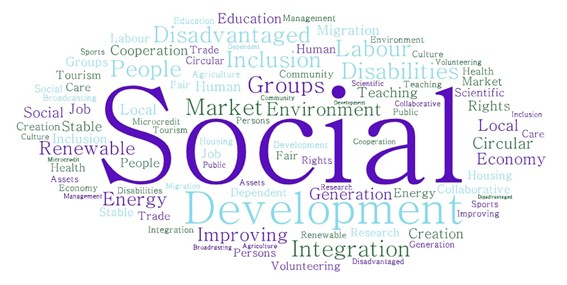
The word cloud (Figure 1) illustrates the main words perceived by students as related to the activities that are the scope of social entrepreneurship, highlighting social development, inclusion, disabilities, integration, labour, market environment, and circular economy.
Figure 1. Activities that correspond to the concept of social entrepreneurship.
Source: Own elaboration.
Table 5 reports the legal forms that can be associated with social entrepreneurship. Although the legal systems of the project partners' countries are very similar, some specificities can be observed concerning the classification of legal forms and/or statutes. Cooperatives, associations, foundations, societies and Non-Governmental Organisations (NGOs) are common to the legal systems analysed. However, Mercy and Private Institutions for Social Solidarity (IPSS) are exclusive to the Portuguese legal system, where no provision for labour societies was identified. We have included the two types of companies in the legal form of mercantile society: share companies and limited liability companies and, in the case of Portugal, commercial companies have not been broken down by type of company. Also, in the Portuguese case, mutual associations were included in the more general legal form of associations.
The most frequently mentioned legal forms are associations (19.0%), foundations (18.7%), NGOs (17.7%), and cooperatives (17.4%), all of which are linked to a high percentage of cases (over 60%). This suggests that these forms are widely recognised as vehicles for social entrepreneurship.
As the respondents could select multiple legal forms, the total percentage of cases (359.0%) suggests that respondents perceive that social entrepreneurship to operate through different organisational models rather than a single dominant structure.
Table 5. Legal forms associated with social entrepreneurship.
|
|
N |
% |
% of cases |
|
Association |
294 |
19.0% |
68.1% |
|
Foundation |
290 |
18.7% |
67.1% |
|
NGO |
275 |
17.7% |
63.7% |
|
Cooperatives |
270 |
17.4% |
62.5% |
|
Trading company |
147 |
9.5% |
34.0% |
|
Labour companies and subsidiaries |
130 |
8.4% |
30.1% |
|
Private Institution for Social Solidarity (IPSS)* |
82 |
5.3% |
19.0% |
|
Mercy* |
56 |
3.6% |
13.0% |
|
Other |
7 |
0.5% |
1.6% |
|
Total |
1551 |
100% |
359.0% |
Note: * Only applied to Portugal
Source: Own elaboration.
4.3.2. Organisational forms
Table 6 presents the results of the university students' perceptions regarding the organisational forms compatible with social entrepreneurship. The majority of students recognise that social entrepreneurship can be pursued through different organisational forms, including enterprises and NGOs. These perceptions are in line with the main research on social entrepreneurship, which emphasises the diversity of organisational models (European Commission, 2020; Defourny & Nyssens, 2010; Meira & Ramos, 2019a).
Table 6. Organisational forms compatible with social entrepreneurship.
|
|
True |
False |
||
|
|
N |
% |
n |
% |
|
Social entrepreneurship is carried out only by social economy organisations/NGOs. |
15 |
3.5% |
419 |
96.5% |
|
Social entrepreneurship is carried out only by an enterprise. |
23 |
5.3% |
411 |
94.7% |
Source: Own elaboration.
4.3.3. Scope of social entrepreneurship
Regarding the objectives of social entrepreneurship initiatives (Table 7), the results strongly indicate that it is widely perceived as a model that is primarily focused on creating sustainable social value (95.6%) and directly or indirectly serving the general interest (92.4%). Furthermore, most respondents (90.6%) acknowledge social entrepreneurship as a means to address social issues through sustainable business efforts. Likewise, 90.3% affirm that social entrepreneurship aims to create a beneficial social effect while ensuring financial sustainability, emphasising that financial viability is a means rather than an objective.
There is also a clear consensus that social entrepreneurship prioritises people over capital (84.3%) and operates within a participatory and democratic framework (88.7%). These perceptions are in line with the definitions of social entrepreneurship by Meira and Ramos (2019b).
In addition, a considerable majority (94.5%) perceive social entrepreneurs to be driven primarily by a strong desire to address social or environmental challenges.
In contrast, claims linking social entrepreneurship to profit maximisation were largely rejected. Only 6.2% think it is solely a business venture focused on making a profit, and 12.7% agree that its primary aim is to enhance shareholder returns. This reinforces the difference between social entrepreneurship and traditional for-profit businesses.
The data presented indicates that the emphasis of social entrepreneurship for the participants is on social benefit, long-term social change, participatory management, and the prioritisation of people. Additionally, it highlights the importance of financial, social, and environmental sustainability while rejecting profit as the sole objective.
Table 7. Aims of social entrepreneurship.
|
|
True |
False |
||
|
|
N |
% |
N |
% |
|
Social entrepreneurship aims to create sustainable social value. |
415 |
95.6% |
19 |
4.4% |
|
Social entrepreneurship directly or indirectly pursues the general interest. |
401 |
92.4% |
33 |
7.6% |
|
Social entrepreneurship is the practice of solving social problems through sustainable business initiatives. |
393 |
90.6% |
40 |
9.2% |
|
The goal of social entrepreneurship is to create positive social impact while being financially sustainable. |
392 |
90.3% |
42 |
9.7% |
|
Social entrepreneurship is a participatory and democratic formula |
383 |
88.7% |
49 |
11.3% |
|
In social entrepreneurship, people take precedence over capital |
366 |
84.3% |
68 |
15.7% |
|
A social entrepreneur must have a strong motivation to solve social or environmental problems. |
409 |
94.5% |
24 |
5.5% |
|
Social entrepreneurship is the act of undertaking a business solely to generate profit. |
27 |
6.2% |
406 |
93.8% |
|
The goal of social entrepreneurship is to maximise profits for shareholders. |
55 |
12.7% |
378 |
87.3% |
Source: Own elaboration.
There are, however, some
significant differences in the students' perception of some of the objectives
of social entrepreneurship. Although the majority considers that social
entrepreneurship involves solving social problems through sustainable business initiatives,
there is a statistically significant difference between the genders, with women
demonstrating greater agreement with this idea, while men tend to express more
disagreement (
The perception that the goal of
social entrepreneurship is to maximise profits for shareholders is also
statistically different between respondents in different age groups ( Respondents aged 21-23 are significantly less likely to agree that
social entrepreneurship aims to maximise profits for shareholders, disagreeing
more than expected, while respondents aged 18-20 are significantly more likely
to agree with this statement (as participants aged 27-39 and more than 40, but
in a small proportion), suggesting they are more inclined to associate social
entrepreneurship with profit maximisation. This suggests that younger
respondents (18-20) may have a more traditional business-oriented view of
social entrepreneurship, while those aged 21-23 are more likely to reject this
perspective.
Respondents aged 21-23 are significantly less likely to agree that
social entrepreneurship aims to maximise profits for shareholders, disagreeing
more than expected, while respondents aged 18-20 are significantly more likely
to agree with this statement (as participants aged 27-39 and more than 40, but
in a small proportion), suggesting they are more inclined to associate social
entrepreneurship with profit maximisation. This suggests that younger
respondents (18-20) may have a more traditional business-oriented view of
social entrepreneurship, while those aged 21-23 are more likely to reject this
perspective.
Furthermore, respondents enrolled
in a bachelor’s degree agree to a greater extent than expected with the
statement that the goal of social entrepreneurship is to generate positive
social impact while being financially sustainable, while those pursuing a
master's degree agree less than expected ( .
.
The association between age and the perception of profit orientation highlights a generational learning process regarding the concept of social entrepreneurship. While younger students appear to interpret entrepreneurship with a more traditional economic perspective, more maturity and exposure to higher education appear to foster a more accurate understanding of the social and sustainable nature of these initiatives. This result suggests that experience and practice are important for a deeper understanding of social entrepreneurship. It is also suggested by the results that the specificities of social entrepreneurship are not exploited by the curricula in different student courses.
4.3.4. Defining success and results
The overwhelming majority (96.8%) recognise that the success of social entrepreneurship is primarily assessed measured by its social impact and improvements in quality of life (Table 8). Most respondents (91.2%) reject the idea that social entrepreneurship should avoid collaborating with other organisations to prevent profit sharing, demonstrating an understanding that collaboration is essential in social entrepreneurship. Over 83% of respondents disagree that financial success is the main criterion for the success of social entrepreneurship, and around three-quarters perceived that social entrepreneurship is not focused on economic profit, unlike traditional businesses. However, a significant minority (26.9%) considers social enterprises to be profit-oriented businesses.
The majority (82.4%) also disagreed that social entrepreneurship should avoid open innovation and collaboration with communities and other sectors, recognizing the importance of open innovation and partnerships.
Table 8. Social entrepreneurship and results.
|
|
True |
False |
|
||
|
|
n |
% |
n |
% |
|
|
The success of social entrepreneurship is measured by its social impact and improvement in the quality of life of the community. |
419 |
96.8% |
14 |
3.2% |
|
|
Social entrepreneurship should seek to avoid collaboration with other organisations so that profits are not shared. |
38 |
8.8% |
395 |
91.2% |
|
|
The success of social entrepreneurship is measured by the level of income and economic benefits. |
71 |
16.4% |
362 |
83.6% |
|
|
Social entrepreneurship should seek to avoid open innovation and collaboration with communities and other sectors. |
76 |
17.6% |
356 |
82.4% |
|
|
A distinctive feature of social enterprises, as opposed to traditional enterprises, is the pursuit of economic profit. |
116 |
26.9% |
316 |
73.1% |
|
Source: Own elaboration.
If the results indicate a strong
consensus that the success of social entrepreneurship is measured by social
impact and community well-being, however, there are differences in this
perception according to whether participants are involved in entrepreneurship
projects or not ( Individuals who are actively involved in entrepreneurial
initiatives are slightly more likely to question this idea, possibly due to
their exposure to additional success metrics.
Individuals who are actively involved in entrepreneurial
initiatives are slightly more likely to question this idea, possibly due to
their exposure to additional success metrics.
Although the majority of the
participants disagree with the statement that social entrepreneurship should
avoid open innovation and collaboration with communities, there are
associations with gender ( involvement in entrepreneurial initiatives (
 , and family and social ties (
 . Support for open innovation and collaboration with communities in
social entrepreneurship is higher among women, participants involved in
entrepreneurial projects, and those with entrepreneurial networks. This
suggests that exposure to entrepreneurship through personal experience or
family and social networks is important in fostering openness to collaboration
and innovation in the field.
. Support for open innovation and collaboration with communities in
social entrepreneurship is higher among women, participants involved in
entrepreneurial projects, and those with entrepreneurial networks. This
suggests that exposure to entrepreneurship through personal experience or
family and social networks is important in fostering openness to collaboration
and innovation in the field.
Entrepreneurship training has a
significant statistical association with the participants' perceptions that the
distinctive characteristic of social enterprises compared to traditional
businesses is the pursuit of economic profit ( Participants with training are more likely to recognise that social
enterprises are not primarily driven by economic profit, thus distinguishing
them more clearly from traditional businesses. This suggests that
entrepreneurship education reinforces a deeper understanding of the nature of
the mission of social enterprises and highlights the need for a more profound
comprehension of this concept. This finding calls for capacity-building efforts
to clarify the differences between the objectives and business models of social
entrepreneurship initiatives compared to traditional enterprises to enhance a
more informed view of the various dimensions of social entrepreneurship.
Participants with training are more likely to recognise that social
enterprises are not primarily driven by economic profit, thus distinguishing
them more clearly from traditional businesses. This suggests that
entrepreneurship education reinforces a deeper understanding of the nature of
the mission of social enterprises and highlights the need for a more profound
comprehension of this concept. This finding calls for capacity-building efforts
to clarify the differences between the objectives and business models of social
entrepreneurship initiatives compared to traditional enterprises to enhance a
more informed view of the various dimensions of social entrepreneurship.
Overall, the results indicate that participants perceive that the focus of social initiatives to be on social impact and collaboration rather than simply measuring success through economic indicators. They highlight the importance of open innovation and interaction with different communities and sectors as critical components for the success of social entrepreneurship initiatives.
4.3.5. Sustainability and Financing Models
Concerning the sustainability and forms of financing of social entrepreneurship initiatives, the results are shown in Table 9. An overwhelming majority consider the importance of social enterprises for long-term sustainability, with since 93.3% agreeing that social entrepreneurship seeks solutions that are sustainable both socially and environmentally in the long term. The majority (85.3%) disagreed with the idea that sustainability is a secondary concern for social entrepreneurship, indicating that most respondents believe that sustainability plays a more central role. Furthermore, the majority (94.2%) supported the view that social entrepreneurship is sustainable itself through a business model that balances financial sustainability and social impact.
On the sources of funding for social enterprises, the large majority of the respondents (95.1%) agreed that social entrepreneurship can combine different sources of funding, including donations, investments, and reinvestment of profits, and that it is not exclusively dependent on donations (88.0%). This highlights a broad recognition of the financial sustainability model within social entrepreneurship, where hybrid funding strategies play a crucial role in ensuring long-term viability and impact. Their perceptions also focus on long-term sustainability, recognising the importance of balancing social, environmental, and financial sustainability.
Table 9. Sustainability and funding sources.
|
|
True |
False |
||
|
|
N |
% |
n |
% |
|
Social entrepreneurship can combine different funding sources such as donations, investments and reinvestment of profits to achieve its social objectives. |
411 |
95.1% |
21 |
4.9% |
|
Social entrepreneurship is sustainable in the long term through a business model that balances financial sustainability with social impact. |
407 |
94.2% |
25 |
5.8% |
|
Sustainability is fundamental in social entrepreneurship, which seeks solutions that are viable in the long term, both socially and environmentally. |
403 |
93.3% |
29 |
6.7% |
|
Social entrepreneurship is financed entirely by donations. |
52 |
12.0% |
380 |
88.0% |
|
Sustainability is a secondary aspect of social entrepreneurship that is considered after profitability. |
63 |
14.7% |
367 |
85.3% |
Source: Own elaboration.
4.3.6. Innovation
Regarding the relevance of innovation (Table 10), there is a clear recognition (94.9%) of the importance of innovation in social entrepreneurship, especially in the development of social entrepreneurship to develop creative solutions to complex social problems. Similarly, participants consider innovation to be important throughout the project's lifecycle and not just in it’s the early stages, as 89.6% disagree that innovation is only important in the initial phase of the project. The vast majority of respondents (91.2%) reject the notion that innovation is unimportant in social entrepreneurship, suggesting that innovation is widely recognised as crucial and not dependent on traditional business models.
Table 10. Importance of innovation in social entrepreneurship.
|
|
True |
False |
|
|||
|
|
N |
% |
N |
% |
||
|
Innovation is key to the development of social entrepreneurship to develop creative solutions to complex social problems. |
408 |
94.9% |
22 |
5.1% |
||
|
Innovation is only important in the early stages of the project. |
45 |
10.4% |
387 |
89.6% |
||
|
Innovation is not important in social entrepreneurship because it is based on traditional business models. |
38 |
8.8% |
394 |
91.2% |
||
Source: Own elaboration.
There are statistical differences
between genders in the perception of the importance of innovation in social
entrepreneurship. Although both genders predominantly reject the idea that
innovation is not important in social entrepreneurship but only in traditional
business models, women are slightly more convinced of the importance of
innovation in social entrepreneurship than men ( There is also a strong consensus that innovation is essential for
social entrepreneurship to create solutions for complex social problems, with
women showing stronger agreement than men (
There is also a strong consensus that innovation is essential for
social entrepreneurship to create solutions for complex social problems, with
women showing stronger agreement than men (
Respondents generally perceive innovation as a crucial aspect of social entrepreneurship, not limited to traditional business models or limited to the project's early stages, but rather as a continuous process that is essential to effectively and sustainably address and solve social challenges.
4.3.7. Community involvement and local development
Table 11 provides insights into how social enterprises contribute to community involvement and local development. Participants perceive social enterprises as making a significant contribution by creating job and developing local skills (95.6%). This highlights the strong perception of these enterprises as catalysts for local economic growth and development. They also agree that social enterprises actively involve the community in problem-solving and decision-making (95.4%), and work closely with communities to address their specific needs (95.4%), reinforcing that these organisations emphasise participatory development practices. A strong majority (73.8%) perceive social enterprises as engaging with the community mainly through the recruitment of volunteers, showing a common understanding of the role of volunteering. The majority of the respondents (70.5%) reject the idea that social enterprises reduce costs by importing foreign products, implying that social enterprises are perceived to prioritise local resources over imports. Nevertheless, there is no clear consensus on whether social entrepreneurship primarily focuses on solving social problems through its operations and profits.
Table 11. Community participation and promotion of local development.
|
|
True |
False |
||
|
|
n |
% |
n |
% |
|
Social entrepreneurship contributes to the development of the local economy by generating employment and fostering the development of local skills. |
414 |
95.6% |
19 |
4.4% |
|
Social ventures actively involve the community in identifying problems and solutions. |
411 |
95.4% |
20 |
4.6% |
|
Social enterprises work closely with communities to understand and address their needs. |
412 |
95.4% |
20 |
4.6% |
|
Social enterprises involve the community into their operations mainly through the recruitment of volunteers. |
318 |
73.8% |
113 |
26.2% |
|
Social entrepreneurship seeks to solve social problems through its operations and profits. |
213 |
49.5% |
217 |
50.5% |
|
Social entrepreneurship contributes to the development of the local economy by importing foreign products to reduce costs |
127 |
29.5% |
304 |
70.5% |
Source: Own elaboration.
There are differences in
participants' perceptions according to their level of education regarding the
role of social entrepreneurship in local development about importing products
to reduce costs ( . Participants enrolled in master's degrees are more likely to
reject the idea that importing products helps local economic development in
social entrepreneurship than students enrolled in “Other” courses.
. Participants enrolled in master's degrees are more likely to
reject the idea that importing products helps local economic development in
social entrepreneurship than students enrolled in “Other” courses.
Overall, respondents perceive social enterprises as key drivers of community participation and local development, emphasising their role in promoting participatory practices, creating job, and enhancing local skills. There is also a strong recognition of the importance of volunteer engagement and a preference for using local rather than imported resources in their operations. Students perceive cooperation, involvement, and local development as essential components of social enterprises, aligning with the definitions of Meira and Ramos (2019b) and the European Commission (2020). Despite their lack of real-world experience, students' emphasis on sustainable practices and community involvement indicates that they have a socially conscious understanding of entrepreneurship that puts impact above profit. Higher education institutions can develop pedagogical strategies that convert awareness into concrete social innovation initiatives.
Social entrepreneurship is increasingly recognised as a way to address societal problems through innovative and sustainable business approaches accelerating the progress towards the sustainable development goals (GEM, 2024).
Although social entrepreneurship has the potential to provide social benefits and create employment opportunities, the rates of social entrepreneurship are quite low, significantly lower than those found in the field of traditional profit-driven entrepreneurship.
In this context, the aim of this research was to understand higher education students' perceptions of social entrepreneurship, namely, how do they perceive the concept of social entrepreneurship, their involvement in entrepreneurial activities and the extent to which this is influenced by their personal characteristics and backgrounds.
Overall, the study conducted in different countries reveal that, most of the higher education students have a conceptual understanding of social entrepreneurship and the nature of this field of activity, despite their low involvement in entrepreneurial activities.
Higher education students perceive social entrepreneurship as a model primarily focused on creating sustainable social value, addressing social and environmental challenges, pursuing the general interest, and operating within a participatory and democratic framework. They typically link social entrepreneurship with activities focused on social inclusion, especially the integration of disadvantaged groups and individuals with disabilities into the labour market. The role of social entrepreneurship in environmental sustainability, local development, cooperation and stable job creation is also widely recognized by higher education students.
The investigation also reveals the perception of higher education students on the role of the financial dimension in social entrepreneurship. This dimension is seen as a means to ensure sustainability, rather than an end in itself, as in the case of profit-focused business models. Social entrepreneurship is also seen as an activity where people take precedence over capital and whose success is mainly analysed according to social impact and improvement in the community quality of life as well, as collaboration with the community rather than economic and financial indicators such as profits. Innovation and community involvement are also part of higher education students' understanding of social entrepreneurship.
Personal characteristics are just slightly able to condition the way higher education students perceive the concept of social entrepreneurship.
The research shows that there are some gender differences in interpreting the concept of social entrepreneurship, with women attaching greater importance to the social, sustainability, innovation and community related dimensions of the concept.
The role attributed to community connection in the concept of social entrepreneurship is also positively influenced by students' previous entrepreneurial experience.
Although some misunderstandings still are found on the interpretation of the concept of social entrepreneurship, as a noticeable proportion of students perceive social entrepreneurial initiatives as businesses driven by profits, overall the perceptions found are in line with the main definitions of social entrepreneurship in the literature.
The investigation developed also find a significant presence of students who have already been exposed to entrepreneurship education and the positive way in which it can shape their perceptions and engagement in entrepreneurial initiatives.
The findings suggest that Universities can have an important role in training students on entrepreneurship and specifically on social entrepreneurship, and help translate knowledge into concrete social entrepreneurial initiatives. Recognising the nature of social problems means that higher education can be crucial in empowering students with the necessary critical thinking skills and leadership while improving their awareness of social challenges. The creation of specific training programs for higher education students can be valuable in bridging this gap, by creating a training program for skills development and collaborative learning experiences.
Future research should investigate the impact of specific educational methods on students' on engagement in social entrepreneurship initiatives and the development of social entrepreneurship initiatives.
This article was written as part of the Project: EEE3S+ - Erasmus + School for Social Entrepreneurship. N. 2023-1-FR01-KA220-HED-000166140
Funded by the European Union. Views and opinions expressed are however those of the authors only and do not necessarily reflect those of the European Union or the European Education and Culture Executive Agency (EACEA). Neither the European Union nor EACEA can be held responsible for them.
Conflict of interest
The authors declare that there is no conflict of interest, either direct or indirect, with the editors, members of the editorial board, or members of the journal’s scientific committee.
Author’s contribution
Conceptualization- Conceição Castro, Raquel Pereira, Deolinda Meira, Susana Bernardino; Data curation- Conceição Castro, Raquel Pereira, Claudia Pinto; Formal analysis- Conceição Castro, Raquel Pereira, Claudia Pinto; Funding acquisition- Jorge Muñoz, Deolinda Meira; Investigation- Conceição Castro, Jorge Muñoz, Raquel Pereira, Susana Bernardino, Claudia Pinto, Deolinda Meira, Paloma Bel Duran, Gustavo Lejarriaga, María José Vañó, Mario Radrigán, Luis Hernández, Millán Díaz, Luca Gori, Paolo Addis; Methodology- Conceição Castro, Jorge Muñoz, Raquel Pereira, Susana Bernardino, Deolinda Meira, Paloma Bel Duran, Gustavo Lejarriaga, María José Vañó, Mario Radrigán, Luis Hernández, Millán Díaz; Project administration- Jorge Muñoz, Deolinda Meira; Resources- Conceição Castro, Raquel Pereira, Claudia Pinto; Software- Conceição Castro, Raquel Pereira, Claudia Pinto; Supervision- Conceição Castro, Jorge Muñoz, Deolinda Meira; Validation- Conceição Castro, Raquel Pereira; Visualization- Conceição Castro, Raquel Pereira, Claudia Pinto; Writing – original draft- Conceição Castro, Raquel Pereira, Susana Bernardino, Deolinda Meira, Paloma Bel Duran, Gustavo Lejarriaga, María José Vañó, Mario Radrigán, Millán Díaz; Writing – review & editing- Conceição Castro, Raquel Pereira, Susana Bernardino, Deolinda Meira.
Data availability
Access upon request (restricted)
The data underlying the findings of this study are restricted and are not publicly available. However, the authors will provide the data to interested readers upon request.
Statement on the Use of Generative AI:
While preparing this paper, the authors used Deepl to check spelling and grammar. After using this tool, the authors reviewed and edited the content as necessary, assuming full responsibility for the content of the publication.
Abu-Saifan, S. (2012). Social entrepreneurship: definition and boundaries. Technology Innovation Management Review, 2(2).
Addae, A. E., & Ellenwood, C. (2022). Integrating Social Entrepreneurship Literature Through Teaching. Entrepreneurship Education and Pedagogy, 5(2), 225-244. https://doi.org/10.1177/25151274211021999.
Adomako, S., & Nguyen, N. P. (2024). Collaborative entrepreneurship and social innovation performance: Effects of institutional support and social legitimacy. Corporate Social Responsibility and Environmental Management. https://doi.org/10.1002/csr.2900.
Aldrich, H. E. & Yang, T. (2014). How do entrepreneurs know what to do? Learning and organising in new ventures, Journal of Evolutionary Economics, 24(1), 59–82. https://doi.org/10.1007/s00191-013-0320-x.
Asma, A., Xiaobao, P., Hassan, S., Akhtar, S., S. A., Khan, M. A., & Khan, B. U. (2019). Determinants of social entrepreneurial intentions for educational programs. Journal of Public Affairs, 19(2), 1–11. https://doi.org/10.1002/pa.1925.
Austin, J., Stevenson, H. & Wei-Skillern, J. (2006). Social and commercial entrepreneurship: Same, different, or both? Entrepreneurship Theory and Practice, 30 (1), 1-22.
Bacq, S., & Janssen, F. (2011). The multiple faces of social entrepreneurship: A review of definitional issues based on geographical and thematic criteria. Entrepreneurship & Regional Development, 23(5-6),373–403. https://doi.org/10.1080/08985626.2011.577242
Bataineh, M.J., Marcuello, C. & Sánchez-Sellero, P. (2023). Toward sustainability: the role of social entrepreneurship in creating social-economic value in renewable energy social enterprises. REVESCO. Revista de Estudios Cooperativos, 1(143), e85561. https://dx.doi.org/10.5209/reve.85561.
Bel Durán, P.; Lejarriaga Pérez de las Vacas, G. & Martín López, S. (2023). Nuevas fórmulas para promover el emprendimiento social universitario: Una aproximación a la Startups de estudiantes. REVESCO. Revista de Estudios Cooperativos, 1(144), e88654. https://dx.doi.org/10.5209/reve.88654.
Bernardino, S. & Freitas Santos (2015). Papel das motivações do empreendedor na decisão de lançamento da iniciativa social. Portuguese Journal of Finance, Management and Accounting, 1(2), 32-55. http://u3isjournal.isvouga.pt/index.php/PJFMA/article/view/103.
Bernardino, S. & Freitas Santos, J. (2023). Manual de Gestão e Criação de Projetos Sociais. Centro de Estudos Organizacionais e Sociais do Politécnico do Porto. ISBN 978-989-33-4152-0.
Bornstein, D., & Davis, S. (2010). Social entrepreneurship: What everyone needs to know. Oxford University Press.
Braga, J. (2013). Motivações no empreendedorismo social. Dissertação de Mestrado em Gestão de Serviços, Faculdade de Economia do Porto.
Canestrino, R., Ćwiklicki, M. Magliocca, P., Pawełek, B. (2020). Understanding social entrepreneurship: A cultural perspective in business research. Journal of Business Research, 110, 132-143. https://doi.org/10.1016/j.jbusres.2020.01.006.
Chang,Y., Wannamakok, W. & Kao, C. (2022). Entrepreneurship education, academic major, and university students’ social entrepreneurial intention: the perspective of Planned Behavior Theory. Studies in Higher Education, 47:11, 2204-2223. https://doi.org/10.1080/03075079.2021.2021875.
Chen, M. H., Y. Y. Chang, and M. T. Chiang (2017). Human Capital and Career Success of Creative Entrepreneurs: Is Guanxi Network a Missing Link? Journal of Small Business & Entrepreneurship, 29(4), 313–331. https://doi.org/10.1080/08276331.2017.1300849
Dees, J. G. (1998). The Meaning of Social Entrepreneurship. Kauffman Foundation and Stanford University.
Dees, J. (2012). A tale of two cultures: Charity, problem solving, and the future of social entrepreneurship. Journal of Business Ethics, 111(3), 321-334.
Defourny, J. & Nyssens, M. (2010). Conceptions of Social Enterprise and Social Entrepreneurship in Europe and the United States: Convergences and Divergences. Journal of Social Entrepreneurship, 1(1), 32-53, https://doi.ord/10.1080/19420670903442053.
Dickel, P. & Eckardt, G. (2020). Who wants to be a social entrepreneur? The role of gender and sustainability orientation. Journal of Small Business Management, 59(1), 196-218, DOI: https://doi.org/10.1080/00472778.2019.1704489.
Douglas, E., & Prentice, C. (2019). Innovation and profit motivations for social entrepreneurship: A fuzzy-set analysis. Journal of Business Research, 99, 69–79. https://doi.org/10.1016/j.jbusres.2019.02.031.
El-Gohary, H., Sultan, F., Alam, S., Abbas, M., & Muhammad, S. (2023). Shaping Sustainable Entrepreneurial Intentions among Business Graduates in Developing Countries through Social Media Adoption: A Moderating-Mediated Mechanism in Pakistan. Sustainability, 15(3), 2489. https://doi.org/10.3390/su15032489
European Commission (2020). Social enterprises and their ecosystems in Europe. Comparative synthesis report. Luxembourg: Publications Office of the European Union. Available at https://europa.eu/!Qq64ny.
García-González, A.; Ramírez-Montoya, M.S.; De León, G; Aragón, S. (2020) El emprendimiento social como una competencia transversal: construcción y validación de un instrumento de valoración en el contexto universitario. REVESCO. Revista de Estudios Cooperativos, 136, e71862. https://dx.doi.org/10.5209/reve.71862.
GEM (2015). Special Topic Report- Social Entrepreneurship. Global Entrepreneurship Monitor. Available at https://www.gemconsortium.org/file/open?fileId=49542.
GEM (2024). Global Report, titled 25 Years and Growing. Global Entrepreneurship Monitor. Available at https://gemconsortium.org/report/global-entrepreneurship-monitor-gem-20232024-global-report-25-years-and-growing.
Gintere, D., & Licite-Kurbe, L. (2022). Social Entrepreneurship Definition and Essence in the Latvia Context. Research for Rural Development, 37(1), 166-173. https://doi.org/10.22616/rrd.28.2022.024
Hatak, I., Harms, R. & Fink, M. (2015). Age, job identification, and entrepreneurial intention. Journal of Managerial Psychology, 30(1), 38-53, DOI: https://doi.org/10.1108/JMP-07-2014-0213.
Ibarra-Vazquez, G., Ramírez-Montoya, M. S. & Miranda, J. (2023). Data Analysis in Factors of Social Entrepreneurship Tools in Complex Thinking: An exploratory study, Thinking Skills and Creativity, 49, 101381, DOI: https://doi.org/10.1016/j.tsc.2023.101381.
Kickul, J., Mitra, P., Weaver, R. L., Orr, J., & Winkler, C. (2022). Special Issue on Social Entrepreneurship Education. Entrepreneurship Education and Pedagogy, 5(2), 186-191. https://doi.org/10.1177/25151274211040420.
Langer, Claudia (2024). Social entrepreneurship as enactment of social innovation in tourism and hospitality: an analysis of its implementation and functioning. Doctoral thesis. Universitat de les Illes Balears. http://hdl.handle.net/11201/166165.
Leadbeater, C. (1997). The rise of the social entrepreneur. Demos. Available at https://demos.co.uk/wp-content/uploads/2023/03/theriseofthesocialentrepreneur.pdf.
Mair, J., & Marti, I. (2006). Social entrepreneurship research: A source of explanation, prediction, and delight. Journal of World Business, 41(1), 36-44.
Maes, J., Leroy, H., & Sels, L. (2014). Gender differences in entrepreneurial intentions: A TPB multi-group analysis at factor and indicator level. European Management Journal, 32(5), 784–794. https://doi.org/10.1016/j.emj.2014.01.001.
Meira, D. & Ramos, M. E. (2019a). Social entrepreneurship: legislative contributions. RED. Revista Eletrónica de Direito, 2 (VOL. 19), 136- 162. DOI: https://doi.org/10.24840/2182-9845_2019-0002_0006.
Meira, D. & Ramos, M. E. (2019b). Empresas sociais e sociedades comerciais: realidades convergentes ou divergentes? (Social Enterprises and Commercial Companies: Converging or Diverging Realities?). Cooperativismo & Desarrollo, 27(1), 1-33. DOI: https://doi.org/10.16925/2382-4220.2019.01.04.
Meira, D., Bernardino, S., & Martinho, A. L. (2020). Um contributo inovador para o ensino da Economia Social em Portugal: O caso do Mestrado em Gestão e Regime jurídico-empresarial da economia social. In C. Pérez Munoz & I. Hernández Artega (Eds.), Economía social y solidaria en la educación superior: un espacio para la innovación (tomo 3, pp. 149-180). Bogotá: Ediciones Universidad Cooperativa de Colombia. ISBN: 9789587602401. DOI: http://dx.doi.org/10.16925/9789587602425.
Melián, A., Campos, V. & Sanchis, J.R. (2017). La educación de postgrado en Economía Social en la universidad española ¿una asignatura pendiente?, CIRIEC-España, Revista de Economía Pública, Social y Cooperativa, 89, 33-54.
Minga-López D. R., Carrillo Cueva C. & Flores Ruiz D. (2024). Factores que influyen hacia el emprendimiento social en jóvenes universitarios. REVESCO. Revista de Estudios Cooperativos, 147, e96307. https://doi.org/10.5209/reve.96307.
Mohammadi, P., AlHattali,K. S. S., & Alghatrifi, I.N.S. (2024). Rethinking the Boundaries and Definition of Social Entrepreneurship: A Critical Literature Review Business Management and Strategy, Vol. 15, No. 1, 226-240.
Monzón Campos J. L. y Torres-Ortega J. A. (2021). Emprendimiento social en la formación profesional: el caso del País Vasco. REVESCO. Revista de Estudios Cooperativos, 137, e73862. https://doi.org/10.5209/reve.73862.
Murillo Pérez L. M. (2022). ¿Cómo genera valor el emprendimiento social de inclusión socio-laboral? Propuesta metodológica para la identificación y análisis de buenas prácticas. REVESCO. Revista de Estudios Cooperativos, 140, e78927. https://doi.org/10.5209/reve.78927.
Nabi, G., Liñán, F., Fayolle, A., Krueger, N., & Walmsley, A. (2018). The impact of entrepreneurship education in higher education: A systematic review and research agenda. Academy of Management Learning & Education, 17(2), 277-299.
Neck, H., Brush, C., & Allen, E. (2009). The landscape of social entrepreneurship. Business Horizons, 52, 13-19. https://doi.org/10.1016/j.bushor.2008.09.002
Neumann, T. (2020). The Impact of Entrepreneurship on Economic, Social and Environmental Welfare and its Determinants: A Systematic Review. Management Review Quarterly 70 (3): 1–32.
Nicholls, A. (2008). Social entrepreneurship: New models of sustainable social change. Oxford, England: Oxford University Press.
Nicholls, A. (2010). The Legitimacy of Social Entrepreneurship: Reflexive Isomorphism in a Preparadigmatic Field. Entrepreneurship Theory and Practice 34 (4): 611–633. DOI: 10.1111/j.1540-6520.2010.00397.x.
Nicholls, A. & Collavo, T. (2019). The concept of social entrepreneurship. Atlas of Social Innovation.
Parente, C., Diogo, V., Costa, D. (2014). Educação para o Empreendedorismo Social, in Empreendedorismo Social em Portugal, Porto, Universidade do Porto, cap. 13, pp. 357-412.
Popov, E., Veretennikova, A., & Kozinskaya, K. (2018). Formal institutional environment influence on social entrepreneurship in developed countries. Montenegrin Journal of Economics, 14(4), 45–56. https://doi.org/10.14254/1800-5845/2018.14-4.3.
Ramón, L. P., Sigüenza, S. & Atiencie, G. Á. (2024). Análisis comparativo del perfil emprendedor social de líderes y jóvenes universitarios: el caso de la Universidad de Cuenca, Ecuador. REVESCO: revista de estudios cooperativos, (148), 98574.https://revistas.ucm.es/index.php/REVE/article/view/98574
Santos, F. M. (2012). A positive theory of social entrepreneurship. Journal of Business Ethics, 111(3), 335-351.
Saebi, T., Foss, N. J., & Linder, S. (2019). Social entrepreneurship research: Past achievements and future promises. Journal of Management, 45(1), 70–95.
Thompson, J., Alvy, G., & Lees, A. (2000). Social entrepreneurship: A new look at the people and the potential. Management Decision, 38(5), 328–338.
Tong, X. F., Tong, D. Y. K. & Loy, L. C. (2011). Factors influencing entrepreneurial intention among university students. International Journal of Social Sciences and Humanity Studies, 3(1), 487-496.
Wang, W. (2022). Toward Economic Growth and Value Creation Through Social Entrepreneurship: Modelling the Mediating Role of Innovation. Frontiers in Psychology 13:914700. https://doi.org/10.3389/fpsyg.2022.914700
Van Auken, H., Stephens, P., Fry, F. & SILVA, J. (2006). Role model influences on entrepreneurial intentions: A comparison between USA and Mexico. The International Entrepreneurship and Management Journal, 2(3), 325-336, DOI: https://doi.org/10.1007/s11365-006-0004-1.
Younis, A., Xiaobao, P., Nadeem,M. A., Kanwal, S., Pitafi, A. H., Qiong, H., Yuzhen, D. (2021). Impact of positivity and empathy on social entrepreneurial intention: The moderating role of perceived social support. Public Affairs, Volume21, Issue1. https://doi.org/10.1002/pa.2124.
Yunus, M. (2010). Building Social Business: The New Kind of Capitalism that Serves Humanity’s Most Pressing Needs. Public Affairs, New York.
Zahra, S.A., Rawhouser, H.N., Bhawe, N., Neubaum, D.O. and Hayton, J.C. (2008). Globalisation of social entrepreneurship opportunities. Strategic Entrepreneurship Journal, 2 (2): 117-131. https://doi.org/10.1002/sej.43.
Zahra, S. A., Gedajlovic, E., Neubaum, D. O., & Shulman, J. M. (2009). A typology of social entrepreneurs: Motives, search processes and ethical challenges. Journal of Business Venturing, 24(5), 519–532. DOI: 10.1016/j.jbusvent.2008.04.007.
Zaremohzzabieh, Z., S. Ahrari, S. E. Krauss, A. A. Samah, L. K. Meng, and Z. Ariffin. (2019). Predicting Social Entrepreneurial Intention: A Meta-Analytic Path Analysis Based on the Theory of Planned Behavior. Journal of Business Research 96: 264–276. DOI: 10.1016/j.jbusres.2018.11.030.
Zhang, X., Sun, Y., Gao, Y., & Dong, Y. (2022). Paths out of poverty: Social entrepreneurship and sustainable development. Frontiers in Psychology, 13, 1062669. https://doi.org/10.3389/fpsyg.2022.1062669.